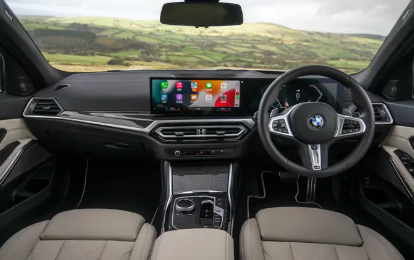

The BMW i5 combines its electric powertrain with a wide range of digital features designed to make driving easier and more enjoyable. Its infotainment system brings navigation, entertainment, smartphone connectivity, and vehicle settings into one integrated environment.
Depending on the model year and equipment package, the car can offer Apple CarPlay, Android Auto, connected navigation services, voice assistance, and wireless smartphone integration. These features help drivers access familiar applications without relying entirely on their phones.
BMW’s navigation system can also support electric journeys by helping drivers locate charging stations and plan routes. This functionality becomes particularly useful when traveling beyond familiar areas. Nevertheless, drivers should verify charger availability and operating status before depending on a particular station.
Another highlight is the customizable digital interface. Drivers can adjust certain displays and access different driving settings to suit their preferences. Furthermore, connected services can provide useful vehicle information, although feature availability may depend on the market, subscription, and software version.
The system adds considerable convenience, but it also creates a learning curve. Drivers who prefer straightforward physical controls may find some functions less intuitive at first. Therefore, spending time learning the interface before setting off can improve the experience.
BMW i5 Safety and Driver Assistance
Safety remains an important consideration in a premium executive sedan, and the BMW i5 offers a selection of driver-assistance and protective technologies. Available equipment can include forward collision warnings, automatic emergency braking, lane-departure warnings, parking assistance, and adaptive cruise control.
However, the exact equipment depends on the model, production year, market, and optional packages. Buyers should check the specification of an individual vehicle rather than assume that every advertised feature comes as standard.
Parking assistance can be particularly helpful because the i5 has a relatively large body. Depending on the equipment, cameras and parking sensors can help drivers judge distances when maneuvering into tight spaces. Advanced parking systems may also offer additional camera views or assistance with selected parking tasks.
Driver-assistance systems can reduce the workload during certain journeys, especially on highways and in slow-moving traffic. Nevertheless, these technologies do not replace attentive driving. Drivers must remain aware of their surroundings and follow the instructions in the owner’s manual.
Before buying, check the safety equipment fitted to the exact vehicle and consult independent crash-test results relevant to its model year and market. This approach provides a clearer understanding of its safety credentials than relying on a feature list alone.
BMW i5 Interior
The BMW i5 interior combines premium materials, modern technology, and exceptional comfort to create a refined driving experience. Its elegant dashboard features BMW’s curved digital display, while ambient lighting adds a stylish atmosphere throughout the cabin. Comfortable seats, high-quality finishes, and a spacious layout make every journey enjoyable. Moreover, the advanced infotainment system supports navigation, entertainment, and smartphone connectivity. Overall, the BMW i5 offers a sophisticated interior that blends everyday practicality with the luxury expected from a premium electric sedan.
BMW i5 Pros and Cons
The BMW i5 offers several benefits, but its drawbacks deserve equal attention.
Pros
- Elegant design: The sleek body, distinctive front styling, and premium proportions create a sophisticated appearance.
- Smooth acceleration: Electric power delivery provides immediate response and effortless everyday performance.
- Quiet cabin: The electric powertrain helps create a relaxed driving environment.
- Modern technology: Digital displays, infotainment features, and available driver assistance add convenience.
- Home-charging potential: Drivers with suitable charging facilities can reduce routine visits to public stations.
- Executive comfort: The sedan combines passenger comfort with a premium interior and practical four-door layout.
Cons
- Premium purchase price: The i5 may cost considerably more than many mainstream electric sedans.
- Range variation: Real-world driving conditions can reduce the distance available between charges.
- Charging dependence: Convenient ownership requires access to reliable charging facilities.
- Heavy construction: The battery adds weight, which can affect the vehicle’s overall driving character and energy use.
- Complex controls: The screen-focused interface may take time to learn.
- Potential ownership expenses: Insurance, tires, repairs, and optional equipment can add to the total cost.
Ultimately, the importance of these advantages and disadvantages depends on individual needs. A driver with home charging and a comfortable budget may prioritize the i5’s refinement, while someone without convenient charging access may find electric ownership less practical.
BMW i5 Price and Ownership Costs
The BMW i5 belongs to the premium electric-car segment, so buyers should consider more than the advertised purchase price. The final cost varies by country, model year, trim, optional equipment, taxes, import duties, and dealer pricing.
For buyers in Pakistan, these factors deserve particular attention. Import costs, registration charges, currency fluctuations, and the availability of qualified repair facilities can significantly affect the cost of ownership. Therefore, international prices should not be treated as accurate local quotations.
Electricity costs also vary according to where and how the car is charged. Home charging may provide predictable running costs, while public fast charging can be more expensive. Drivers should calculate their expected monthly mileage and local electricity rates before estimating potential savings.
Maintenance differs from that of a conventional petrol or diesel vehicle because the i5 does not require engine oil changes or routine exhaust-system servicing. However, it still needs appropriate inspections, tires, brakes, cabin filters, and other maintenance items. Specialized repairs can also become expensive, particularly if the vehicle requires imported components.
Insurance is another important consideration. Buyers should obtain quotations based on the exact vehicle, its value, their location, and the available coverage. In addition, checking the battery warranty, service history, and repair support can help reduce uncertainty when purchasing a used example.
A careful ownership-cost calculation should include depreciation, financing, insurance, charging, maintenance, and potential repairs. This gives a more realistic picture than comparing purchase prices alone.
Is the BMW i5 Worth Buying?
The BMW i5 is worth considering if you want a luxury electric sedan that combines contemporary styling, quiet operation, responsive acceleration, and a technology-rich interior. It provides an alternative to traditional executive sedans without abandoning the comfort and premium presentation associated with the BMW 5 Series.
The eDrive40 may suit drivers who prioritize everyday comfort and rear-wheel-drive performance, while the M60 xDrive caters to those who want stronger acceleration and all-wheel-drive capability. The right choice depends on your budget, driving habits, and preferred balance between performance and efficiency.
However, the i5 may not suit everyone. Its purchase price can be substantial, and drivers without convenient charging facilities must consider how they will recharge the battery. Furthermore, buyers who frequently travel through areas with limited charging infrastructure should plan carefully before making the switch to an electric vehicle.
If you are shopping for a used BMW i5, inspect the battery and charging system, review the service records, confirm the remaining warranty, and check for any outstanding recalls. A professional inspection can also help identify accident damage or other expensive problems.
Before making a final decision, compare the i5 with other luxury electric sedans and consider the total ownership cost rather than focusing on performance figures alone.
Final Verdict
The BMW i5 demonstrates how a familiar executive sedan can evolve into a modern electric car without losing its emphasis on comfort, style, and driving enjoyment. Its elegant exterior, smooth acceleration, advanced infotainment, and refined cabin make it an appealing option for drivers who want premium transportation with an all-electric powertrain.
Nevertheless, the car’s high purchase price, charging requirements, and variable real-world range remain important considerations. These drawbacks do not automatically rule it out, but they make careful planning essential.
For drivers with reliable charging access and a budget that accommodates premium ownership costs, the BMW i5 can provide a comfortable and engaging electric-driving experience. For others, charging access and long-term expenses may outweigh its advantages.
In the end, the BMW i5 offers a compelling combination of luxury and electric performance, provided its capabilities and limitations match your everyday needs.
Technical reference: BMW’s official i5 M60 xDrive technical specifications and BMW Group’s original 5 Series and i5 technical information provide further details on power, acceleration, battery capacity, and vehicle specifications.
